
North Avenue: A Community Rich in History
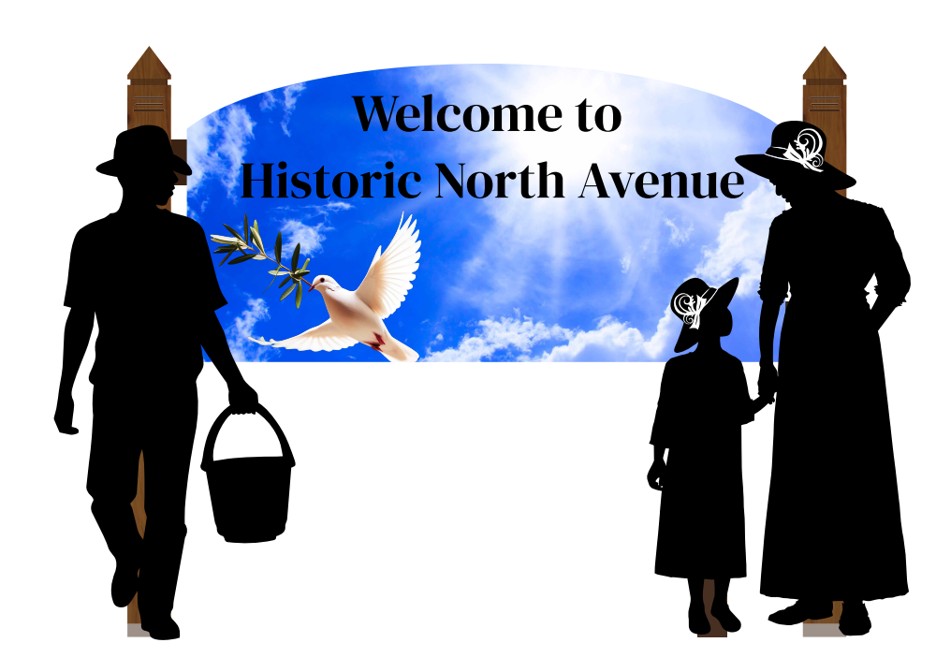
In June 2026, thanks to funding from a Healing Illinois grant and the Sycamore Parks Foundation, a neighborhood sign and interpretive panel were installed at the intersection of North Avenue and California Street to celebrate the history of Sycamore’s North Avenue community.
This neighborhood was selected because of its rich history that is little known by many people. A traditionally Black neighborhood for many years, the North Avenue community has played an important role in Sycamore’s history through its churches, families, veterans, civic leaders, and workers at the nearby Anaconda factory. Today, this project helps ensure those stories are preserved and shared with future generations.
The sign features three figures that represent the people who shaped the neighborhood. A man carrying a bucket symbolizes the many residents who walked from their homes on North Avenue and Lucas Street to work at the nearby Anaconda factory. A woman wearing a detailed hat and dress reflects the traditional attire of women in Israel of God’s Church. A child represents the many families who lived in the neighborhood and the children who gathered each day to wait for the school bus on North Avenue.
The interpretive panel highlights the histories of Israel of God’s Church, North Avenue Baptist Church, and the Anaconda factory. The information below expands on those stories. Visit createchange.today to explore oral histories, photographs, and additional research about Black and Latino communities in DeKalb County.
Israel of God’s Church
The interpretive panel introduces the history of Israel of God’s Church, but its influence on the Sycamore community extends far beyond is shared on the sign.
Several church members served their country with distinction. Samuel Crosswell was a Buffalo Soldier and World War I veteran. Maddie Jackson, a Sycamore High School graduate, served with the historic 6888th Central Postal Directory Battalion during World War II, sorting mail for American troops in Europe. Mildred Poole Stewart, another church member, is honored with a memorial plaque at North Avenue and Brickville Road.


Additionally, other members played important roles in local government. During the 1980s and 1990s, Wesley Coats served two terms as president of the City of Sycamore Human Relations Committee. Rev. Henry Wilson and Vernon Alexander also served on the committee, while George Bridgewater served on the Zoning Board. Wesley Coats additionally served on the city’s Planning Committee. Their service reflects the long tradition of civic involvement fostered by Israel of God’s Church.
North Avenue Baptist Church
Although fewer historical records exist for North Avenue Baptist Church, the Anaconda employee newsletter, Wire Crier, provides valuable insight into the lives of several church members.
Wever Johnson worked at Anaconda for much of his life. His story illustrates the local impact of the Great Migration. While living in Georgia, he received a train ticket to Sycamore to work at the Anaconda factory, where he built a new life.
Victor Harris, was also featured in Wire Crier. Born in Georgia, Harris later lived in Chicago and Evanston before meeting a woman from Sycamore. Shortly after they married in 1925, he was involved in an accident that resulted in the loss of both legs. After months of rehabilitation, Harris returned to work at Anaconda using prosthetic legs. During this time, he also devoted himself to ministry and eventually became pastor of North Avenue Baptist Church.
The newsletter concluded that “Vic’s grit and determination and his remarkable success in overcoming a great handicap should be an inspiration to everyone.”


More recently, Jim Bailey was interviewed for the Black Oral History Project and shared his memories of growing up in this church. A key word search with his name to listen to a clip of story.
Anaconda
The Anaconda factory was one of the area’s largest employers and one of the few local industries that hired Black workers during the early and mid-twentieth century. Many employees had moved north during the Great Migration, and for those living on North Avenue and nearby streets, the factory was within walking distance of home.
The Wire Crier newsletters provide a remarkable record of daily life at the factory, documenting employee activities, community events, and the lives of workers and their families. During World War II, the newsletter regularly recognized employees serving in the military, including Cecil Caldwell, William Bridgewater, and Oscar Whitlock, all of whom lived near the plant.
Arts in Action
The North Avenue sign and interpretive panel are part of the Arts in Action project, a collaborative initiative between the DeKalb County History Center and the Ellwood House Museum. Through community partnerships, oral histories, exhibits, and public art, Arts in Action works to share stories that have too often been overlooked, creating a more complete understanding of the people and places that have shaped DeKalb County.
Do You Have a Story?
Share All Histories